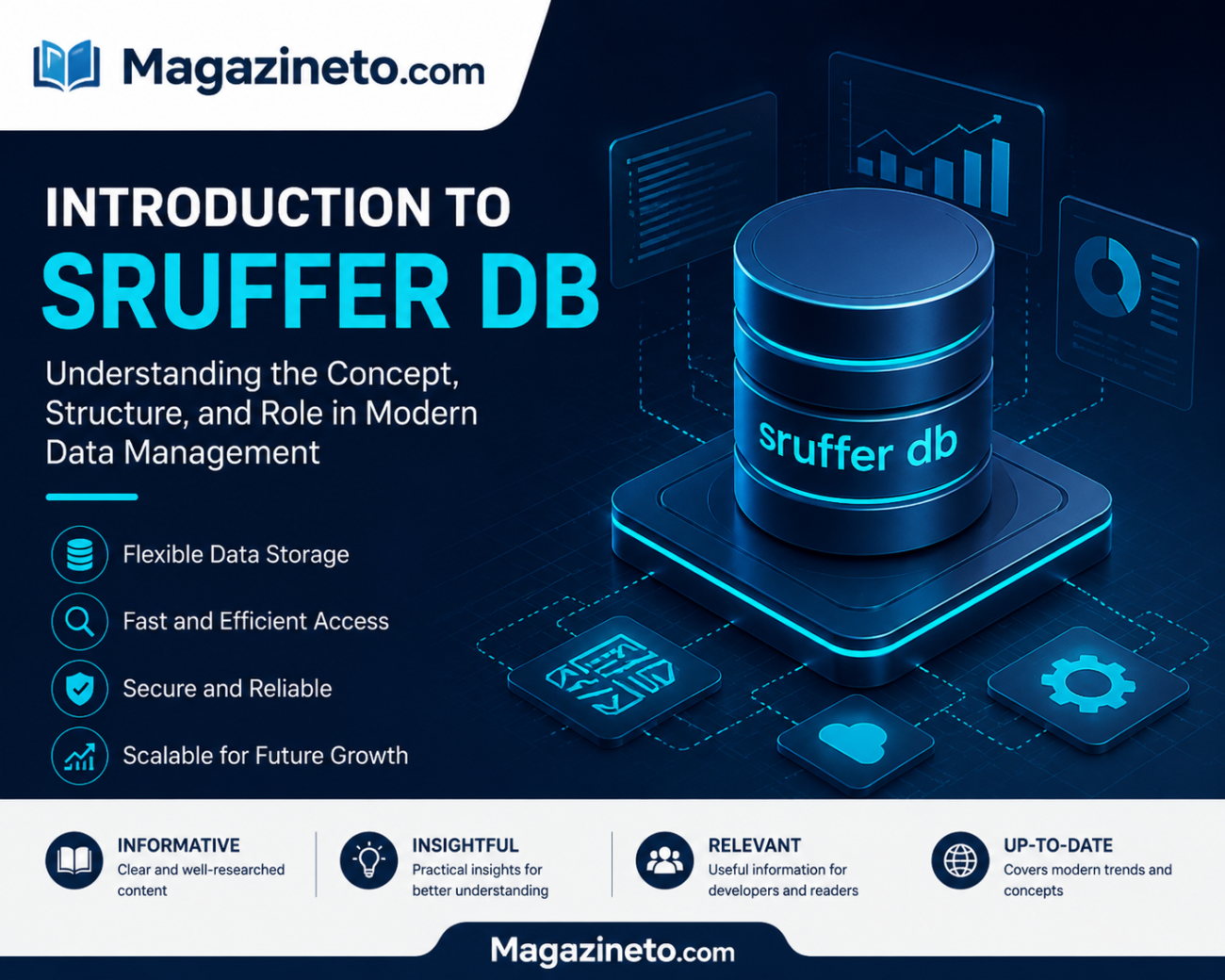
Introduction to sruffer db
The term sruffer db appears in online discussions in different contexts, but there is no widely accepted technical documentation that defines it as a standard database product. Because of this, it is best understood as a conceptual or emerging reference to a database-style system rather than a clearly established commercial technology. In many cases, such terms appear when people try to describe new ways of handling data storage, search, and retrieval in digital systems.
To understand sruffer db properly, it is useful to step away from branding and focus on the core idea: how modern applications store and manage data efficiently. Whether the term refers to a real system, an experimental tool, or a conceptual model, the underlying discussion revolves around database design, performance, and flexibility.
Before breaking down sruffer db, it is important to understand what a database does in any system. A database is not just a storage unit. It is an organized system that allows applications to store structured and unstructured information, retrieve it when needed, update it, and maintain consistency across users and processes.
Every digital product depends on some form of database. Websites store user accounts, apps store activity logs, businesses store transactions, and platforms store content.
When people refer to sruffer db, they are usually pointing toward a system that aims to improve how this data is handled, especially in terms of speed, structure, and flexibility.
The idea behind sruffer db
Sruffer db can be interpreted as a model that focuses on flexible data organization. Traditional databases often require strict structure before data is stored. Tables must be defined, relationships must be mapped, and rules must be set in advance. This works well for stable systems, but it can become limiting when data types change frequently.
The idea behind sruffer db, as it appears in conceptual usage, is to reduce this rigidity.
In simple terms, the goal is to make data handling less restrictive while still maintaining control over performance and reliability.
Structured vs flexible data handling
To understand the relevance of sruffer db, it helps to compare structured and flexible data systems.
Structured databases store data in tables with predefined columns. This makes them reliable for reporting, transactions, and consistent queries. However, they require planning and cannot easily adapt to unexpected changes in data format.
Flexible systems, on the other hand, allow data to exist in different forms. This can include documents, key-value pairs, JSON objects, or mixed formats. These systems are easier to scale when requirements change but may require additional effort to maintain order and consistency.
Sruffer db is often discussed as a balance between these two approaches, aiming to combine structure with flexibility.
Possible architecture of a system like sruffer db
Although there is no official architecture publicly documented, we can describe how a system labeled as sruffer db would likely be designed based on modern database principles.
Such a system would typically include a storage layer, an indexing system, a query processor, and a security layer. The storage layer would handle raw data, while the indexing system would make retrieval faster by organizing references. The query processor would interpret user or application requests and fetch relevant results. The security layer would manage authentication and permissions.
In more advanced designs, distributed storage might also be included. This would allow the system to spread data across multiple servers, improving scalability and reliability.
Role of indexing and search efficiency
One of the most important parts of any database system is how quickly it can return results. This depends heavily on indexing. Indexing is a method of organizing data so it can be found without scanning everything from the beginning.
In the context of sruffer db, indexing would likely play a central role. This means supporting fast search operations even when datasets grow significantly.
Efficient indexing also reduces server load, improves response time, and supports real-time applications such as dashboards, analytics tools, and content platforms.
Data consistency and reliability
Another important aspect of any database system is consistency. For example, when a user updates a record, the change should be reflected everywhere the data is used.
If sruffer db follows modern database principles, it would need to manage consistency carefully, especially in environments where multiple users or systems are accessing data at the same time.
Reliability is closely connected to this. A reliable database ensures that data is not lost due to system failure, crashes, or unexpected interruptions. This is usually achieved through replication, backups, and fault-tolerant design.
Scalability in modern data systems
Scalability refers to the ability of a system to handle increased workload without losing performance. In real-world applications, data rarely stays at the same level. It grows continuously as users, transactions, and interactions increase.
A system like sruffer db, if designed for modern use cases, would need to scale both vertically and horizontally. Vertical scaling means improving the power of a single server.
Horizontal scaling is often preferred in large systems because it allows more flexibility and reduces dependency on a single machine.
Security considerations
Security is a core requirement in any database system. Data often includes sensitive information such as user details, financial records, or internal business data. Protecting this information is essential.
In a system like sruffer db, security would involve multiple layers. These include authentication (verifying users), authorization (controlling access levels), encryption (protecting stored and transmitted data), and monitoring (detecting unusual activity).
Without strong security measures, even a well-designed database system becomes risky for real-world use.
Use cases where such a system could be applied
If we treat sruffer db as a modern flexible database concept, it could be applied in several areas. E-commerce platforms could use it to manage products, orders, and customer data. Analytics platforms could rely on it for processing large volumes of event data.
It could also be used in applications that require fast updates and dynamic structure, such as social media platforms or real-time dashboards.
The key requirement in all these cases is the ability to manage changing data efficiently without heavy restructuring.
Challenges in defining sruffer db
One of the main challenges with terms like sruffer db is lack of standard definition. Without clear documentation or official specification, it becomes difficult to determine exactly what the system includes or how it should be implemented.
This creates ambiguity in technical discussions. Developers may interpret the term differently, leading to inconsistent understanding. In some cases, such terms are used loosely to describe ideas rather than actual products.
Because of this, any analysis of sruffer db must be based on general database principles rather than fixed technical documentation.
Comparison with established database systems
Established database systems such as relational databases and NoSQL databases have well-defined structures and clear use cases. Relational databases focus on structured data and strong consistency. NoSQL systems focus on flexibility and scalability.
Sruffer db, as a conceptual idea, appears to sit between these two models. It suggests a system that does not fully commit to rigid structure but still maintains organization and performance.
However, without official specifications, it cannot be directly compared as a competitor to existing systems. Instead, it should be viewed as part of the broader evolution of database thinking.
Importance of clear documentation in database systems
In software development, documentation is essential. It helps developers understand how a system works, how to use it, and what limitations it has. Without documentation, even powerful systems become difficult to adopt.
If sruffer db is intended as a real system or framework, proper documentation would be necessary for adoption. This would include setup instructions, query formats, architecture details, and best practices.
Without this clarity, the term remains more theoretical than practical.
Role of databases in modern applications
Regardless of terminology, the role of databases in modern applications remains central. Every digital system depends on structured data handling. Whether it is a small website or a large-scale enterprise platform, data management determines performance and reliability.
Systems that aim to improve database functionality must focus on real-world problems such as speed, scalability, security, and ease of integration. These are the areas where innovation matters most.
Future direction of database concepts
Database technology continues to evolve toward more flexible, distributed, and efficient systems.
If concepts like sruffer db are part of this evolution, they would need to align with these trends. This includes supporting distributed architecture, real-time access, and flexible data structures while maintaining reliability.
Conclusion
Sruffer db can be understood as a loosely defined or conceptual database-related idea that reflects modern challenges in data management. While it is not clearly established as a formal database system, it represents the ongoing need for flexible, scalable, and efficient data handling solutions.
Instead of focusing on the term itself, the more important discussion is about what modern systems require: fast access, structured and unstructured data support, security, and scalability.
In that sense, sruffer db can be seen as part of a broader conversation about how databases are evolving rather than a fixed product with strict technical boundaries.
