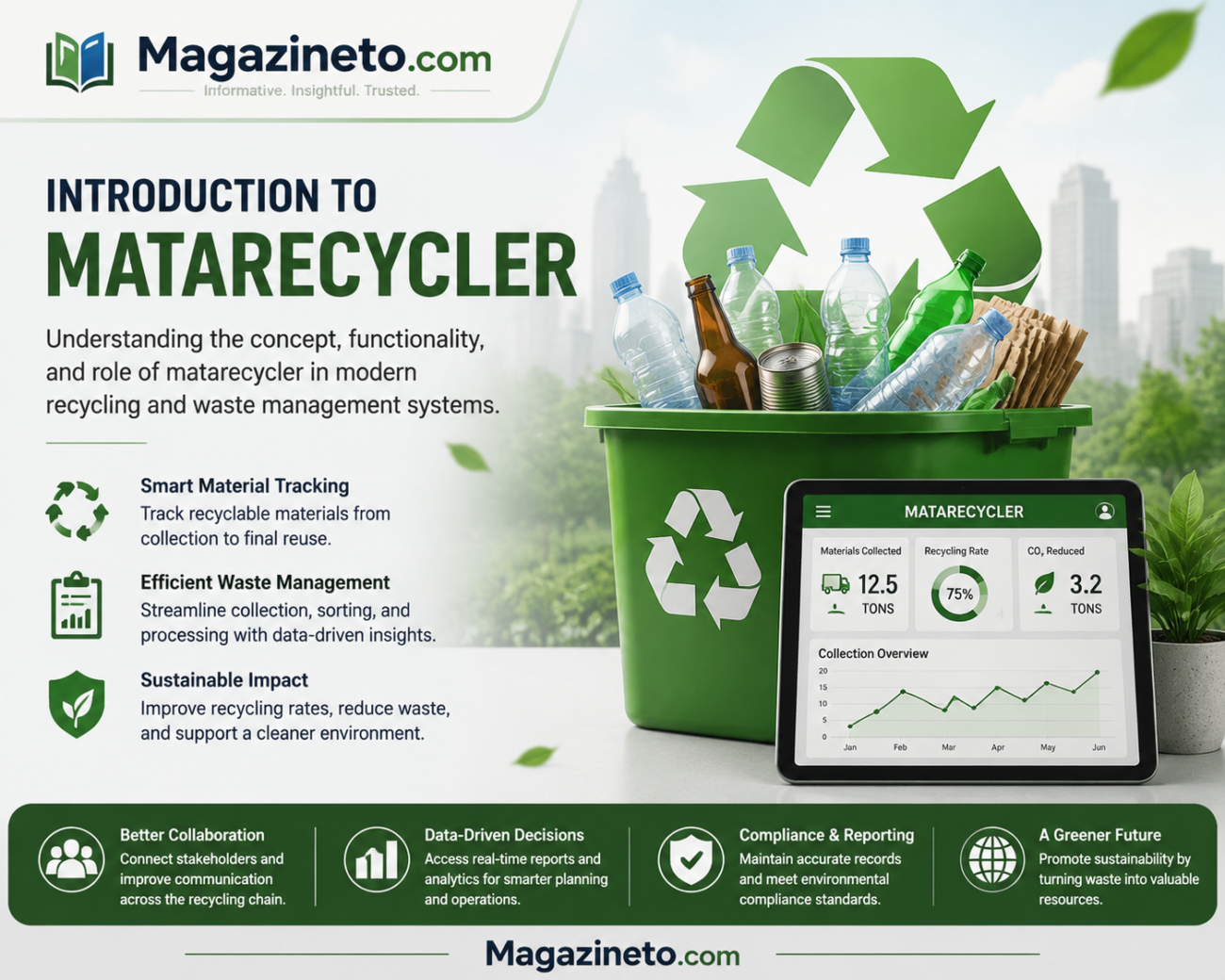
Introduction to matarecycler
The term matarecycler does not appear in widely established technical or industrial documentation, but it is increasingly used in discussions around recycling systems, material recovery workflows, and digital tracking of waste processing. In many contexts, such terms are used to describe systems that manage recycling data, coordinate material collection, or support industrial recycling operations through software or structured processes.
To understand matarecycler in a practical sense, it is useful to treat it as a concept rather than a fixed product. It can represent a system that connects material waste collection, sorting, processing, and reporting into a single managed workflow. Whether applied in physical recycling plants or digital tracking systems, the idea focuses on improving how recyclable materials are identified, processed, and reused.
Understanding the core idea behind matarecycler
At its foundation, matarecycler can be seen as a structured approach to handling recyclable materials. Recycling itself involves multiple stages: collection, sorting, processing, and redistribution. This can lead to inefficiencies, missing data, or delays in processing.
A system like matarecycler would aim to bring these stages together into a more connected workflow. Instead of treating recycling as isolated steps, it would track materials from the point of collection to their final reuse.
The key idea is control over material flow.
Why recycling systems need structured management
Recycling is not only about collecting waste. It is also about understanding what happens to that waste after it enters the system. Without structured management, recycling programs often struggle with inconsistent data and unclear material tracking.
For example, a municipality may collect thousands of tons of waste, but without proper classification, it becomes difficult to know how much of it is actually recycled. Similarly, industrial recycling plants may handle large volumes of material but lack clear visibility into efficiency or output quality.
A concept like matarecycler addresses this problem by introducing structure. It suggests that every stage of recycling should be recorded, monitored, and analyzed. This includes the type of material, its source, its processing method, and its final outcome.
Material tracking as a central function
One of the most important aspects of a system like matarecycler is material tracking. This involves following recyclable items from the moment they are collected to the point where they are processed into reusable material.
Tracking can include simple identification such as categorizing waste into plastic, metal, glass, or organic material. It can also include more detailed data such as weight, contamination level, origin location, and processing status.
When this information is recorded consistently, it becomes possible to understand recycling efficiency in a more accurate way. It also helps identify bottlenecks in the system, such as delays in sorting or low-quality input materials.
Role of data in modern recycling systems
Modern recycling operations increasingly depend on data. Without data, it is difficult to improve performance or make informed decisions. This is where systems like matarecycler become relevant in a conceptual sense.
Data in recycling systems can include collection schedules, transportation logs, facility processing times, material recovery rates, and resale or reuse statistics. When this data is organized properly, it allows operators to optimize routes, improve sorting techniques, and reduce operational costs.
A structured system would not only store data but also help interpret it. This could involve reporting dashboards, performance summaries, or trend analysis over time.
Sorting and classification processes
Sorting is one of the most critical stages in recycling. Incorrect sorting leads to contamination, which reduces the value of recycled materials and increases processing costs.
In a system like matarecycler, sorting data would play a key role. Each batch of collected material could be classified based on type and quality. This classification would then guide how the material is processed further.
For example, metals may be sent to smelting facilities, plastics to reprocessing units, and paper to pulping systems. Accurate classification ensures that each material follows the correct path through the recycling chain.
Efficiency in recycling workflows
Efficiency in recycling depends on how well each stage of the process is coordinated. Delays in collection, poor sorting, or inefficient transport can reduce overall system performance.
A structured approach like matarecycler would focus on reducing these inefficiencies by linking each stage together. When collection data is connected to processing data, it becomes easier to identify where delays occur.
This feedback loop improves overall efficiency over time.
Role of technology in recycling management
Technology plays a growing role in modern recycling systems. Digital tools can be used to track waste movement, monitor processing equipment, and generate performance reports.
Instead of relying on manual records, data would be captured automatically or semi-automatically at different stages.
This reduces human error and improves the reliability of information. It also makes it easier to scale recycling operations across multiple locations.
Environmental reporting and accountability
One of the challenges in recycling systems is proving environmental impact. Governments, organizations, and companies often need to report how much waste they recycle and how it contributes to sustainability goals.
A structured system like matarecycler would make this reporting more transparent. By tracking materials throughout the recycling process, it becomes easier to generate accurate reports on recycling rates, landfill reduction, and material recovery.
Without reliable data, it becomes difficult to assess performance.
Supply chain connection in recycling
Recycling is closely connected to supply chains. Recycled materials often re-enter manufacturing processes as raw inputs. For example, recycled plastic can be used to produce packaging, textiles, or construction materials.
A system like matarecycler would likely include supply chain visibility.
When supply chain data is connected to recycling data, businesses can better understand material flow and reduce dependence on new raw materials.
Challenges in implementing structured recycling systems
Despite its benefits, implementing a structured system like matarecycler comes with challenges. One major challenge is data consistency. Recycling systems involve multiple stakeholders, including households, transport companies, sorting facilities, and manufacturers. Each of these may record data differently.
Another challenge is cost. Setting up digital tracking systems, training staff, and maintaining infrastructure requires investment. Smaller municipalities or companies may find it difficult to adopt such systems quickly.
There is also the issue of standardization. Without common standards for data collection and classification, integrating information across different systems becomes difficult.
Scalability and expansion of recycling systems
As recycling programs grow, scalability becomes important. A system that works for a small city may not be suitable for a large region or national-level program.
A concept like matarecycler would need to support expansion without losing performance. This means handling larger volumes of data, more users, and more complex material flows.
Scalability also involves adapting to different types of recycling operations. Industrial recycling has different needs compared to municipal waste management, so the system must be flexible enough to handle both.
Importance of transparency in waste management
Transparency is a key factor in modern environmental systems. People and organizations want to know how waste is managed and what happens to it after collection. Without transparency, recycling programs lose credibility.
A structured system like matarecycler would improve transparency by providing clear records of material flow. This includes where waste originates, how it is processed, and what percentage is successfully recycled.
Transparent systems also help identify inefficiencies and improve trust between stakeholders.
Future direction of recycling systems
Recycling systems are moving toward more digital and data-driven models. Manual tracking is being replaced by automated systems that provide real-time information. This allows faster decision-making and better resource management.
If systems like matarecycler continue to evolve, they may become part of larger environmental management platforms. These platforms could integrate waste management, energy usage, and sustainability reporting into a single system.
The future of recycling will likely depend on how well data and physical processes are combined into unified workflows.
Conclusion
Matarecycler can be understood as a conceptual model for structured recycling management. It represents the idea of connecting material collection, sorting, processing, and reporting into a single organized system. While the term itself is not widely documented as a formal product, it reflects real challenges in recycling systems today.
The core value of such a concept lies in improving efficiency, transparency, and accountability in waste management.
In practical terms, matarecycler highlights the growing need for structured, data-driven approaches in environmental management and recycling operations.
